

"The eye with which I spot the wrist is not the same with which the wrist sees me."
by Endre Cserna
The most interesting visual experience for me last year happened on the most surprising platform, and it has continued to captivate my imagination ever since, especially considering that the images themselves may not necessarily be interesting at first glance. The Csukló Spotting (Wrist-spotting or Watch-spotting – maybe an unintentional – wordplay on Trainspotting) Instagram page started its operation in 2021, but I only discovered it sometime last spring. The microblog is essentially dedicated to listing and showcasing selfies, and press and event photos of Hungarian celebrities, mainly politicians, athletes, journalists, and influencers – members of the Hungarian (media) elite. Csukló Spotting highlights what kind of wristwatches these people are wearing exactly in the images, along with their outrageous price-tags.
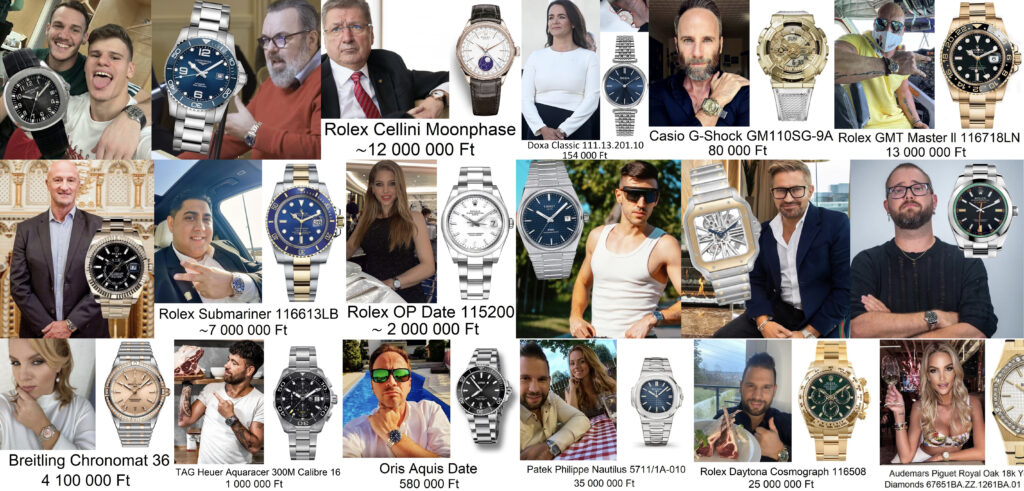
Since I'm not particularly a big fan of wristwatches, I'm not familiar with the subculture that admires them. At first, my interest naturally lay in their prices and the significant social gap recognisable through them – the watch of any parliamentary representative can equal the value of the annual salary of a Hungarian high school teacher. Of course, this was just a very simple observation, an angry clash with the capitalist system, and a reflection of how the Hungarian public life operates, which is not at all different from other everyday experiences where one recognises and becomes aware of the gaping holes in our societies – indeed, realising that no one is interested in finding solutions to our common problems. "This is not an exit." What is truly powerful in the abundance of these images, collectively, is that through them – in these completely insincere, spoofed "self-portraits" and portraits – something seems to manifest from the Hungarian hyperreality and from the state of Hungarian culture, revealing how we deal with lack of or the slow disappearance our common (social, cultural, and maybe every other types of) values. And what takes their place is primarily perceptible in this visual experience, indirectly sensed.
This is somewhat nuanced by the fact that the page itself does not present these valuable objects and their owners in a "critical" manner at all, instead, it does so with sincere admiration and respect, without thematising how an individual can acquire such expensive items. But I'm not naive, I'm aware that a media personality, an athlete, or an entrepreneur can create such prosperity for themselves in the free market. The truly significant aspect of these images, however, lies in the fact that the individuals depicted in them mostly did not become wealthy through their performance, work, or perseverance in the free competition of capitalism. Instead, we see figures close to the current government who, in this way, have bypassed capitalism through (corruption and) connections. The debasement and the loss of values in Hungarian public life, radiates from these images, heightened by the truly tasteless graphic elements that make them even more obscene, and the comments of which almost all of them celebrates the „excellent choices,” the „elegant leather straps” and the „easily readable dials”. Everyone is successful, happy, and confident – whether it's a far-right politician, a trash-celebrity known from reality shows, or a problematic performer living off government commissions.
My petty indignation towards the super-rich is not interesting – what is truly intriguing and imaginative is that this thematically composed portrait gallery can gaze upon us just like Gerhard Richter's work titled "48 Portraits," if we are capable of overlooking the profane surface and context, including Instagram’s front-end noisiness. The composition of faces predominantly seen in the Instagram grid – mostly men – forms a tableau of the country's most well-known and influential figures. As a visual experience, considering the totality of the networked images, the melancholic quality of public life unfolds before us: in the Hungarian hyperreality, there are no common issues, no culture beyond the low-quality programs of commercial channels & the pages of tabloids or government-controlled media, no shared experiences beyond the scene of the rather empty football stadiums – and artists, creators, or "public intellectuals" are missing all from this environment dominated, led, and permanently diverted by these prevailing forces in the country. What Gerhard Richter achieves with the inward-turning gazes (only Kafka looks us in the eye!) and the ties, glasses, and balding Modernist heads in his paintings, Csukló Spotting's "appropriated" vernacular photographs capture in its images of mostly empty and deceitful gazes faking happiness or contentment, self-satisfaction, and, of course, the wristwatches that, in every selfie, find their way into unnaturally contorted poses for the camera, as if they were the heirs to the gloves and dagger in Hans Holbein's portrait of Henry VIII.


