
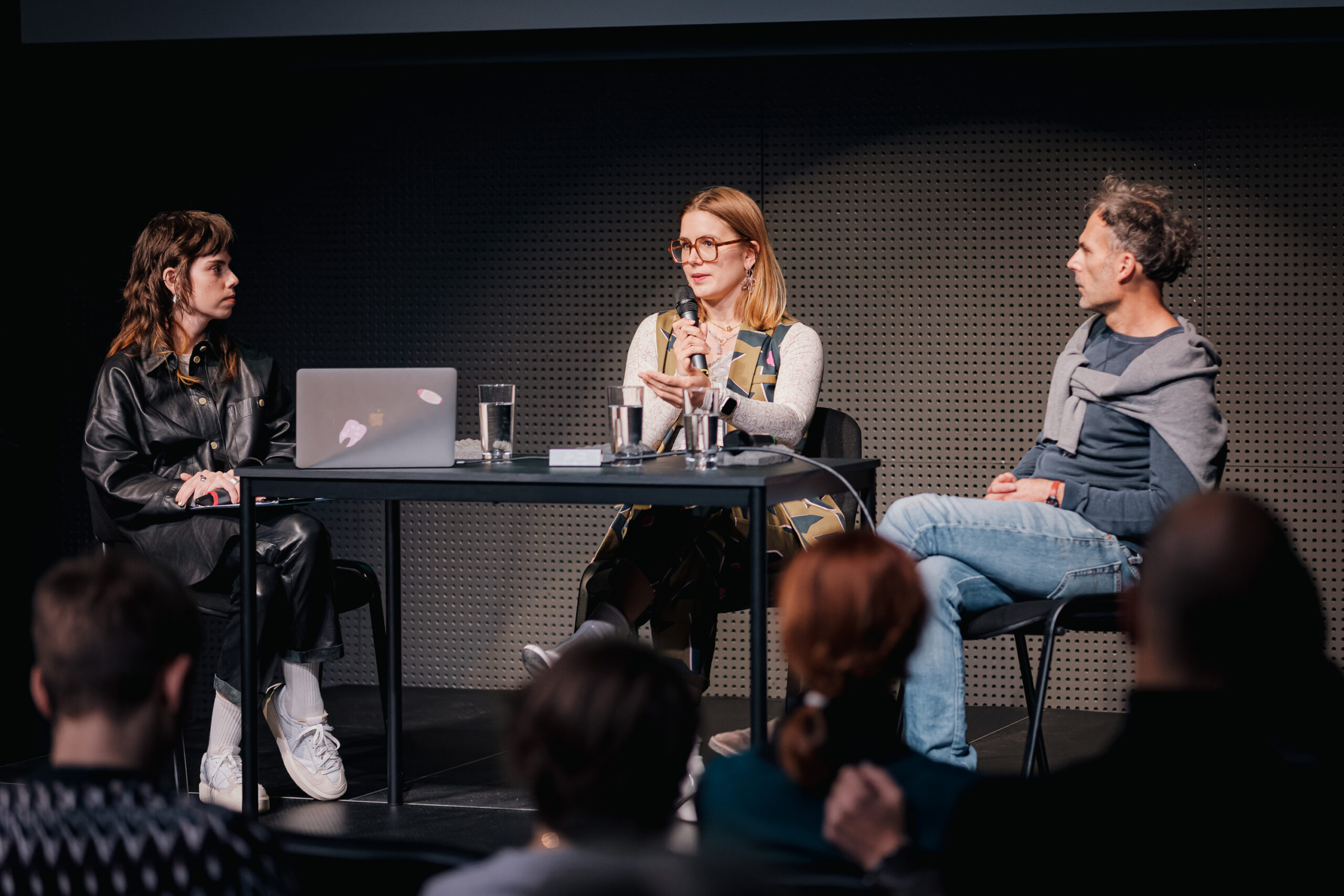
When someone takes up the challenge of showcasing photographs on a website or as part of a print publication, more often than not faces the limitations of copyright. Therefore, the second panel discussion of Eidolon Centre for Everyday Photography hosted by Capa Center focused on the detailed explanation of the current copyright system using Fortepan as a case study. The guests were Dr. Flóra Gubicz copyright lawyer and Miklós Tamási, the founder of Fortepan. The discussion was moderated by the director of Eidolon Centre, Róza Tekla Szilágyi.

From left to right: Róza Tekla Szilágyi, dr. Flóra Anna Gubicz, Miklós Tamási, photo: Capa Center
Copyright – how does it work?
As Dr. Gubicz highlighted in the beginning, copyright essentially works in favor of artists and their offsprings, successors. By controlling the secondary use of artworks, copyright helps artists to gain royalty payment and urges them to publish their artworks. It also ensures that the purchasing of an artwork only provides ownership – in order to rightfully use, reproduce and publish the acquired piece, a copyright license agreement is needed. Since copyright protects any kind of artwork created by a natural person, it applies to family photographs as well. So, while Fortepan owns the everyday photographs gifted to or acquired by their archive, they can’t rightfully publish them since their practice doesn’t involve contractual agreements.
When the system becomes the obstacle
Based on this, the solution should just be a signature away. However, Miklós Tamási pointed out that while some of their photographs are donated by the creator or their family members, many is considered orphan work, meaning snapshots with unknown authors. To further complicate the situation, the latter category is also automatically protected by copyright – seemingly unnecessarily, since everyday photographs aren’t created with artistic intentions. As Dr. Gubicz explained, in order to rightfully publish copyrighted photographs the user has to obtain their license from HUNGART, the Collecting Society of Hungarian Visual Artists, even if it’s an orphan work. Fundamentally, HUNGART’s purpose is to help artists handle the legal procedure around the mass reproduction of their artworks. After seventy years of the author’s death, the copyright terminates and the works become public domain and free to use. However, this operation poses serious obstacles when it comes to orphan works since their author and time of creation remains uncertain.

dr. Flóra Anna Gubicz, photo: Capa Center
The odd one out
Although the legal system around publishing everyday photographs wouldn’t allow Fortepan’s functioning as it is happening now, the archive is still frequently used and generally loved. Tamási accounted only a few instances when they were asked to remove certain pictures from their website. Aside from a larger institution’s legal claims, the reasons were mainly personal. One time, the famous Hungarian singer, Klári Katona requested some of her wedding photos, found in a photographer’s archive, to be removed. Another case involved a man who came across a photograph depicting his father by an unknown lady’s side. He was worried about his elderly mother finding the picture – both of these cases were understandably sensitive and showcased how the moral context has to always be prioritized by public archives handling family photographs. On the other hand, legal issues should not deter similar initiatives from publishing valuable everyday photographs, as Tamási emphasized. So, the question arises: could our common interests overwrite seemingly unreasonable legal procedures?

Miklós Tamási, photo: Capa Center
Not every interest is common
Tamási also brought up the situation around the oeuvres of famous Hungarian photographers, unpublished by the archives owning them. After seventy years from the passing of the artist the legal protection terminates – so, why can’t we freely access for instance the works of Moholy-Nagy? An audience member and former director of the Hungarian Museum of Photography, Károly Kincses pointed out an understandable reason: the handling of artworks provides additional income for cultural institutions. István Virágvölgyi, one of the directors of Capa Centre added that even if they wanted to make the Capa oeuvre free to use, the institution would risk a potential conflict with other foreign organizations licensing the photographs.
Could there be a legal solution?
As an example, Dr. Gubicz pointed out the registration-based copyright system that previously operated in the USA. Now protection is also granted automatically overseas, however, in order to exercise the right, people have to register. A copyright system like this could mean a solution in Hungary as well since it would allow unregistered – so orphan photographs – to be used freely. Unfortunately, the internationality of the copyright system currently at place poses a serious obstacle; in order for it to change, there would have to be a major consensus among the nations.
This article is a summary from our event titled Questions about showcasing vernacular photography vol. 2 that was held on November 21, 2023 at the Capa Center in Budapest.
The article was created with the support of the National Cultural Fund of Hungary.


