
Old vernacular photographs of nightlife and drinking
by David Ford
In the final essay in this series, David Ford looks at how developments in photography changed the way social lives were recorded.

Silver gelatin print, Naples, 1950s, photographer unknown
I bought this photograph ten years ago from a second-hand bookshop on the Piazza Dante in Naples. It shows a group of working-class Italian men enjoying a drink. Perhaps they are celebrating a birthday, or a sporting victory or the end of a hard shift at the warehouse or restaurant where they work. Although the picture itself is stained and torn, it remains a potent image of happiness, capturing without any artifice the undiluted joy and camaraderie of this informal occasion. It is a picture of men drinking but not of drunkenness. I recognise in the faces of these men the male relatives from my own family who worked in hard manual jobs in the industrial north of England. Although the photograph was taken in Naples it could just as easily have been taken in Liverpool, Hamburg or Baltimore. It dates from the early 1950s and it would have been unusual to find pictures like this before then. It had taken photography over a hundred years to reach the point where spontaneous images of ordinary working people enjoying a night out could be produced.
From the beginning, people wanted photography to document every aspect of their lives, including how they enjoyed themselves. But it was not until travelling photographers adopted the tintype process in the 1860s that this started to become a reality. Itinerant tintype photographers took portrait photography out of the studio to where ordinary people went for entertainment; to carnivals, fairs and seaside resorts. The pictures they produced were small, cheap and available within minutes – the first instant photographs. Now even the poorest could have a photographic memento of a special day out and because they were cheap, the poses are often more casual than those found in studio portraits.
By the early years of the 20th century, most travelling photographers were using smaller cameras and silver gelatin film rather than glass plates. From 19051 onwards most of the photographs they produced were in the postcard format.2 Photographers could now go in search of subjects rather than waiting for the sitters to come to them. The pictures they produced could be sent to family and friends or simply kept as a personal memento.3 Some of the pictures were still taken outside and show customers and staff in front of hostelries.

Photo-postcard, Germany, 1914, photographer unknown

Photo-postcard, Germany, 1914, photographer unknown
However, faster exposure times enabled photographers to take pictures inside cafes and bars as well.

Photo-postcard, Germany, 1905, photographer unknown

Photo-postcard, Germany, photographer unknown
Some of the pictures are more animated and show men messing around for the camera. The subjects in these early photographs are nearly always men, reflecting the social conventions of the time.

Photo-postcard, Germany, photographer unknown

Photo-postcard of men drinking, photographer unknown
One odd twist on the ‘wish you were here’ pictures taken by itinerant photographers are those of soldiers drinking during the First World War.

Photo-postcard of two soldiers, photographer unknown
The soldiers smile and raise their glasses of beer for the camera. These pictures are also in the form of postcards. Were they meant to reassure family back home or were they produced as a form of propaganda?

Photo-postcard of German soldiers, photographer unknown
Portfolio 23 of August Sanders People of the 20th Century4 contains a picture of soldiers drinking beer on Christmas 1915. This photograph is similar to the one above taken by an anonymous commercial photographer. Both are unsentimental and objective and show the same wooden table and blank, staring, faces. Although the photographer in both cases was keen to capture a generic image of soldiers rather than a portrait of specific individuals, the pictures remain poignant because we know this may have been the last photograph of the men ever taken.
The 1920s and 30s were the age of parties and cabaret and dressing up. This was a time of new-found freedoms, the pursuit of pleasure, and of drinking to forget both the shadow of war and economic depression. The photobooth provided a way for people to express themselves in private, enabling them to capture casual, intimate moments, away from the prying eyes of others. Jobbing commercial photographers prowled the boulevards of Paris and other cities, taking pictures of tourists drinking outside cafes and bars.

Photo-postcard, Paris, 1930s, photographer unknown
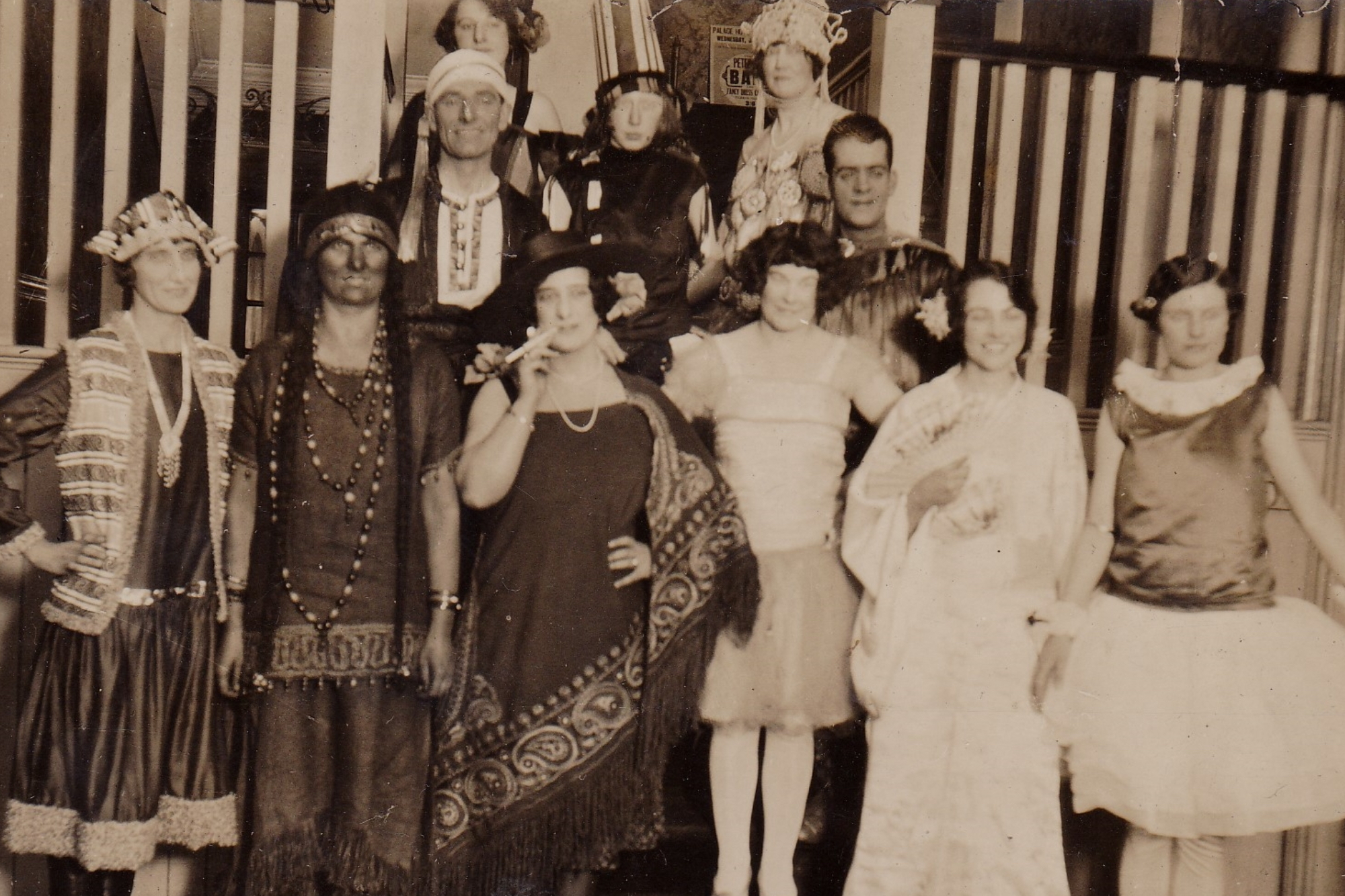
However, the most evocative pictures from this period are the group photographs from beer houses and carnival and fancy-dress parties. These were taken by professional studio photographers using large format cameras and flash that was short enough for people not to close their eyes but powerful enough to capture large groups in dimly lit venues.5

Italian Night, July 1929, photographer unknown

Hamburg, 1930s, photographer unknown
These are the first real vernacular photographs of nightlife. It is the faces here that fascinate us, their features exposed and frozen by the flash as if they have literally been ‘caught’ by the camera.6 Unlike earlier photographs, women now appear alongside men reflecting changing social attitudes.

Photo-postcard, photographer unknown
These pictures are not imitating paintings or prints. The revel in what photography can do best – to objectively capture the moment. Photography was now part of everyday life and people were no longer intimidated or scared by it. They had learnt how to embrace the camera, how to pose and how to make a picture more interesting.7

Fancy dress photograph, Aachen, 1930s, photographer unknown

Fancy dress photograph, 1920s, photographer unknown
Dressing up was popular in the interwar years, whether at fancy-dress parties or part of Mardi Gras celebrations.8 These are pictures of the privileged, of the ‘bright young things’. They are the modern, urban equivalent of the fête galante paintings popular in 18th century Rococo Europe.

Fancy dress photograph, 1930s, photographer unknown
Fancy dress was used to subvert societal norms, providing an opportunity to behave in ways deemed unacceptable in daily life. It offered a safe space for self-expression and a cover for the illegal gay scene. Cross dressing for both men and women was acceptable and men often rouged and powdered their aces. There is something excessive and decadent about these pictures but falling over them, like a shadow, is the sense that it will all come to an end, that the fun cannot last forever.

Fancy dress, Berlin, 1930s, photographer unknown
Vernacular photographs of nightlife changed rapidly in the second half of the twentieth century. Technical improvements to cameras and film made photography simpler, quicker and cheaper. By the 1950s flash bulbs and electronic flash were common and the wider availability of materials for home processing meant that more amateurs developed their own pictures. Commercial street photographers used 35mm film and small SLR cameras to take pictures in nightclubs, restaurants and bars. The sixties saw the arrival of High Street processing and simple point and shoot cameras, Colour film replaced black and white. Polaroids gave people the freedom to instantly document the most intimate moments in their lives. Now nights out were captured by those involved rather than professional photographers. By the start of the new Millenium digital photography had replaced analogue film. In 2002 the first camera phones were introduced and soon the selfie pose replaced all others.
Although techniques and formats changed, the poses in vernacular photographs of nightlife remain remarkably consistent. These photographs, taken at least fifty years apart, capture things in a similar way.

Hunting party, early 20th century, photographer unknown

Germany, 1970s, photographer unknown

Photo-postcard, Germany, 1916, photographer unknown

Snapshot, Spain, 1970s, photographer unknown

Students, Germany, 1920s, photographer unknown

Vienna, 1970s, photographer unknown
For over 150 years, vernacular photographs have captured the freedom, romance and excitement of our social lives. How we spend our nights out, and how we record them, may have changed but we still want photographs to help us remember our happiest times. From the first murky tintypes to Instagram selfies, photography has documented our desire to spend time with others. When we look at old pictures of nightlife we recognise in the faces our own need to have fun and to share good times. Happiness looks just the same now as it did decades ago and that is why these pictures still move us.
David Ford is a writer and artist based in London. He has been a collector of vernacular photography for over twenty years. The two previous essays in this series can be found here and here.
[1] ‘From around 1905, individually printed ‘real photograph’ cards began to appear.’ Editor Robert Lenman, Oxford Companion to the Photograph, Oxford University Pres, 2005, page 518.
[2] Although the box brownie camera was introduced in 1900, film and processing were still relatively expensive and until the 1950s nearly all snapshots taken by amateurs were taken outside in bright sunshine, hence the proliferation of summer holiday pictures and near absence of early snapshots showing ordinary people’s nightlife.
[3] Of the postcards from this period in my own collection, approximately a third have been written on and mailed.
[4] See August Sander, National Portrait Gallery, 1997, page 111.
[5] Flash bulbs appeared in 1920s but at first many photographers continued to use flash powder. Electronic flash appeared in 1940s.
[6] ‘There were two men with a lot of explosive powder taking photographs in another room. Their flashes and bangs had rather disquieting effect on the party causing a feeling of tension, because everyone looked negligent and said what a bore the papers were, and how too like Archie to let the photographers come, but most of them, as a matter of fact, wanted dreadfully to be photographed’ Evelyn Waugh, Vile Bodies, Little Brown, 1930, page 66.
[7] An interesting study might be on how cinema changed the way people posed in front of the camera.
[8] ‘Oh, Nina, what a lot of parties (…Masked parties, Savage parties, Victorian parties, Greek parties, Wild West parties, Russian parties, Circus parties.’ Evely Waugh, Vile Bodies, Little Brown, 1930, page 170.


