
The Photobooth at 100
by Catlin Langford
The first photobooth, the Photomaton, debuted on Broadway, New York on 21 September 1926. (1) It was the invention of Siberian Anatol Josepho. Arriving in the United States in 1923, by September 1926, he had five viable Photomaton machines and opened his Photomaton studio. (2) Josepho later recalled: ‘I felt that it would be a great thing commercially to invent a machine that would automatically photograph the sitter and develop negatives’. (3) Automatic photography machines had, however, existed since the late nineteenth century.
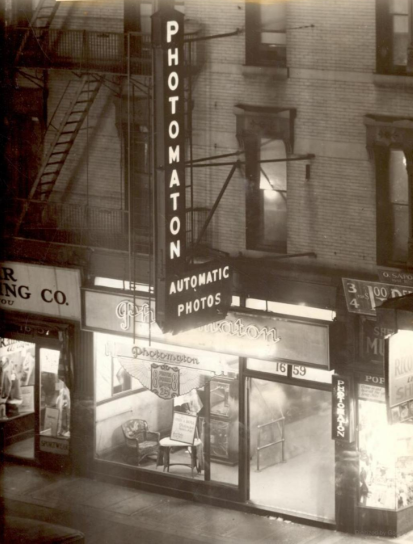
Photomaton Studio at 1659 Broadway, photographed c.1927
The first practical automatic photography machine publicly debuted at the 1889 Exposition Universelle in Paris. (4) The invention of French Ernest Théophile Enjalbert, the machine resembled a tower. (5) All mechanisms, chemicals and water required for the processing of photographs were contained inside. A person, or user, would sit on a chair in front of the machine. Upon inserting a coin, the user was automatically photographed, and after a short wait, their likeness was deposited as a ferrotype, better known as a tintype. Numerous automatic photography machines subsequently launched internationally. This includes the Bosco Automat in Germany, invented by Carl Bernitt. The ‘Bosco’ toured internationally, including stints in Australia in the 1890s and 1900s. (6) These machines aligned with the then emerging culture of vending machines, offering the public the means to purchase commodities without human assistance. While initially popular, issues with the photography machines ranging from lack of automation to double exposures, meant that they ultimately proved unviable.
There was therefore already a culture and understanding around automatic photography machines when the Photomaton debuts on Broadway. But the Photomaton presented a few key variations from its predecessors. Notably, its form. Compared to prior automatic photography machines, the Photomaton required the visitor to physically enter the machine. It is therefore the first “photobooth”. (7) The popular press was conscious of this difference, alerting the public to its form via comparisons to an ‘elongated telephone booth’. The Photomaton consisted of a wooden container. An opening revealed a stool, which could be adjusted to the required height. Above the stool, facing the user, was a large bank of electric lightbulbs. Opposite the stool was the camera and an interior darkroom, hidden behind a glass panel. A slot at the back of the machine distributed the photographs. Announcing the machine in November 1926, the British Birmingham Daily Gazette reported: ‘The subject takes his seat in a small booth and when he is ready to pose drops a “quarter” in the slot. A bright light shines on his face and at intervals of a few seconds eight exposures are made.’ (8)
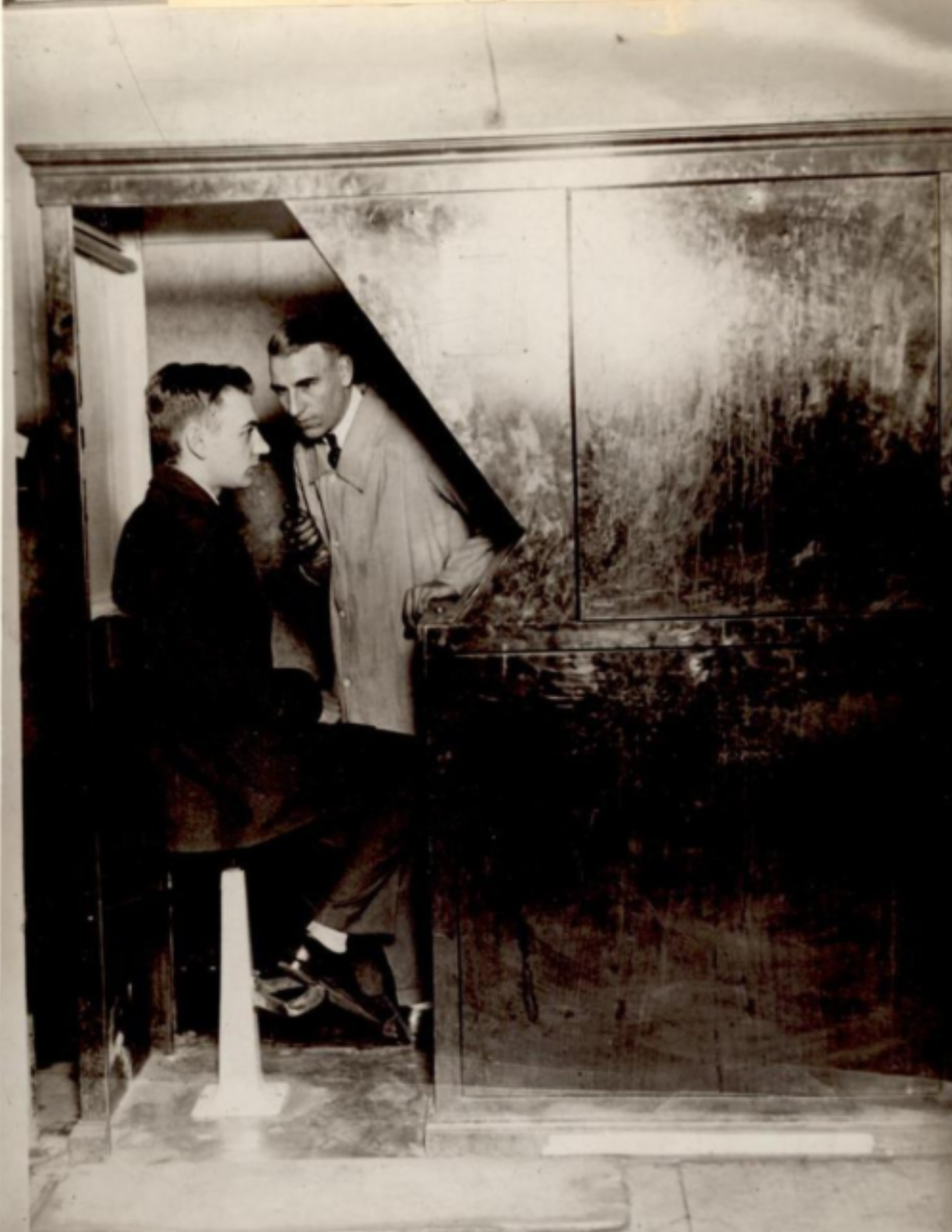
View of the Photomaton, c.1927
As a further point of comparison, the Photomaton offered users a strip of gelatin silver prints. Josepho’s use of a strip format likely stems from his background in ‘ping pong’ photography, reportedly having run a ‘ping pong’ studio in China. (9) Ping pong photographs, and penny photographs, were terms used interchangeably in the early twentieth century to refer to small, inexpensive photographs. (10) Ping pong photographs, specifically, however, were the result of a camera which ‘ping-ponged’ between exposures via a sliding frame manipulated by the photographer. The resulting photographs were commonly presented on a single strip of photographic paper. This forms a clear lineage between ‘ping pong’ photographs and the Photomaton strip. In Josepho’s Photomaton, the machine automatically feeds the paper over the lens, corresponding to the release of the shutter and the creation of an exposure. The strip is then ‘dip and dunked’ to form positive images, which are then fixed, washed, and released to the user. Initially a sitting in the machine involved eight exposures, producing a strip of eight separate frames, and only one strip of photographs could be developed at a time.
On this understanding of its form and function, the 1926 Photomaton photobooth forms a clear parallel to the analogue machines which can still be witnessed in cities like Berlin, Paris, London and Melbourne today.
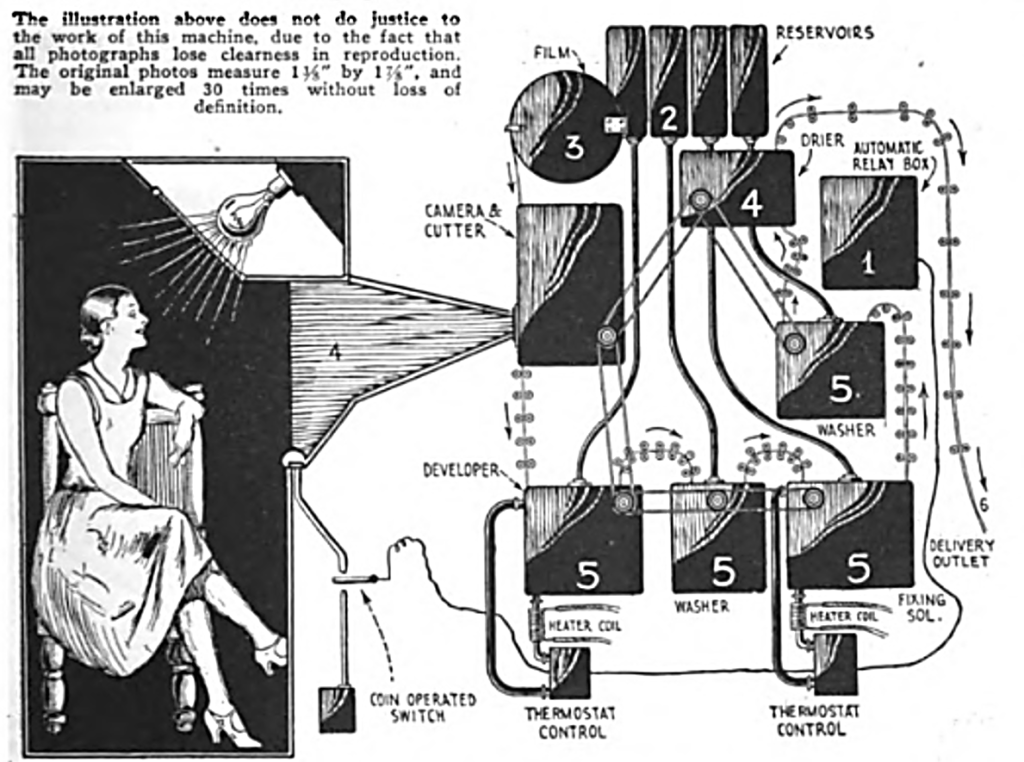
Diagram illustrating the inner elements of Photomaton, as published in ‘Quarter in Slot and Photomaton Delivers Eight Pictures’, Science and Invention, January 1927, 781.
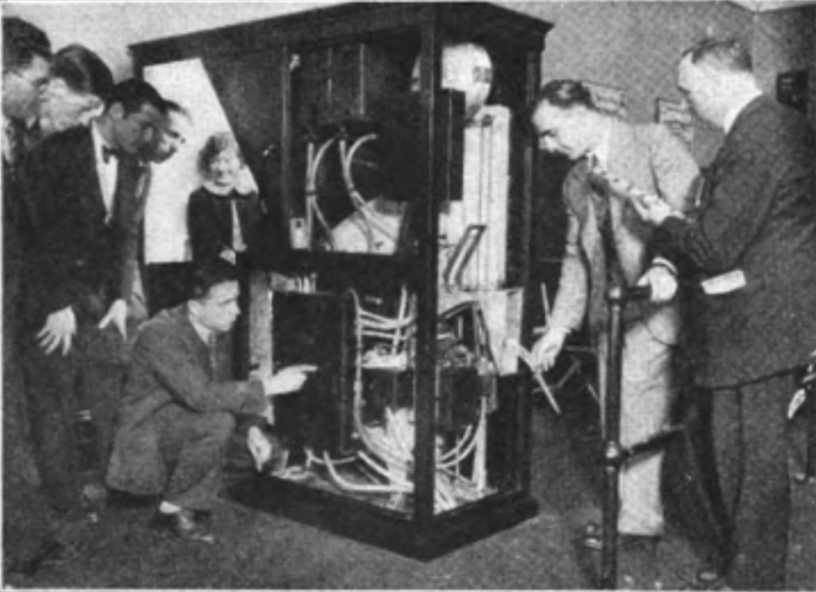
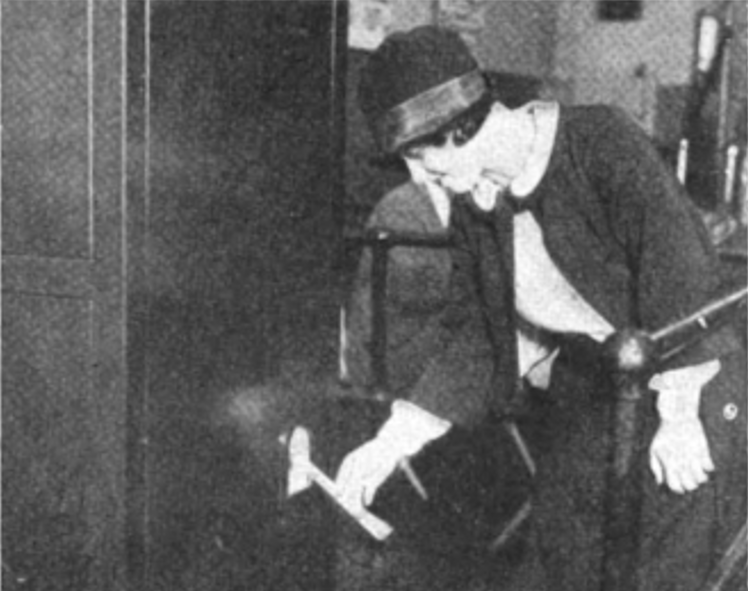
Anatol Josepho demonstrating how the Photomaton works in January 1927 and a woman collects her strip, as reproduced in ‘Quarter in Slot and Photomaton Delivers Eight Pictures’, Science and Invention, January 1927, 781.
But a significant point of difference lies in the machine’s sense of privacy. Contemporary accounts of the photobooth commonly discuss the machine’s sense of solitude, or secrecy, via a curtain which shields the user inside. This gives the booth the pretence of privacy, despite its situation in often very public spaces. Early accounts of using the machine indicate this was not a feature of the original design. Instead, as Josepho’s patent and later photographs reproduced in the press indicate, there was no mechanism to shield the user from public view. Instead, at the Photomaton’s inception, outside patrons could easily view and interact with the user as they posed for the Photomaton’s camera. The booth featured an open design, with the user viewable on both sides of the machine. This, it seems, was part of the machine’s appeal. A British article from 1926, entitled ‘Birth of a Giggle’ describes the Photomaton as the new ‘Broadway game’: ‘[g]iggling friends on either side of the sitter usually try to upset his or her poise. It is far more difficult than would be thought, and full of amusement for lookers-on to try to invent eight different expressions in a minute.’ (11)
To assist with inventing eight different expressions, Photomaton attendants were commonly positioned beside the machines. While the machines were fully automated, the attendants, often women, assisted the user with its operation. (12) They also directed the user to achieve the most flattering poses during their sitting. In a Photo-Era Magazine article, Mary Elizabeth Prim described her experience using a machine in Boston in November 1927:
A little girl in a rakish beret and blue smock coos, “Next, please”, and you pop into one of the three booths. You seat yourself on a white enamelled stool, which has to be adjusted to your height… “Drop in your quarter, please.” You do, and instantly there beats upon you a great white light… “Look into the camera and smile” orders the blue-smocked attendant. You gave straight ahead with bright, imbecile concentration. “Look to the right, and smile!” you are urged. Which you do, and encounter the gaze of a solid phalanx of onlookers, many of whom titter hysterically. “Now, to the left and smile!” You obediently shift your profile which now feels as if they clay had just been poured on for the death-mask. “Look at me, and please smile,” coaxes the attendant, peering in at you with a driven look. “Fine! Now, to the other side and smile!” The crowd on the other side has increased, and regards you with unwavering interest, commenting on your features in a free, though kindly manner. Fortunately, you cannot hear the comments. “Into the camera and s-s-s-s-s-smile!” Whereupon, in a last desperate effort at joviality, you grin with such fury that the muscle of your neck ache all afternoon’. (13)
The article makes apparent that using the Photomaton was not a private experience, as Prim is subject to the watchful eyes and commentary of crowds positioned outside the machine.
The capacity to view, comment and even interact with the user made the machine an amusement and spectacle. Further underlining this understanding were Photomaton advertisements which encouraged users to create a narrative from the eight-frame format and transform oneself into a ‘film star’ via ‘‘mak[ing]-your-own-movies-for-a-quarter’. (14)
Here, it is worth considering Josepho’s release of the Photomaton on Broadway. By 1926, alongside musicals and vaudeville, films with synchronised sound were first being shown on Broadway, paving the way for ‘talkies’, or ‘talking’ films. (15) The establishment and opening of the Photomaton studio on Broadway is therefore significant in defining the identity of Josepho’s machines as part of this entertainment culture, and transforming users into film stars, albeit very briefly. It worked, and his Photomaton studio proved immensely popular, with reports that it was ‘besieged nightly by queues of amused theatre parties’. (16)
The studio’s enormous popularity inspired the sale of Josepho’s shares in the Photomaton company in 1927, for a recorded US$1,000,000 to a group of investors. Their plans involved extensive expansion, both within the United States and the world. (17) Towards the end of the 1920s, Photomaton studios were opening across major city centres worldwide, including in London in 1928. Advertisements for the machine featured full-page illustrations and articles. One example, published in the Daily Mirror in March 1928 declared that the Photomaton is ‘DESTINED TO REVOLUTIONISE THE ART OF THE CAMERA’. (18)
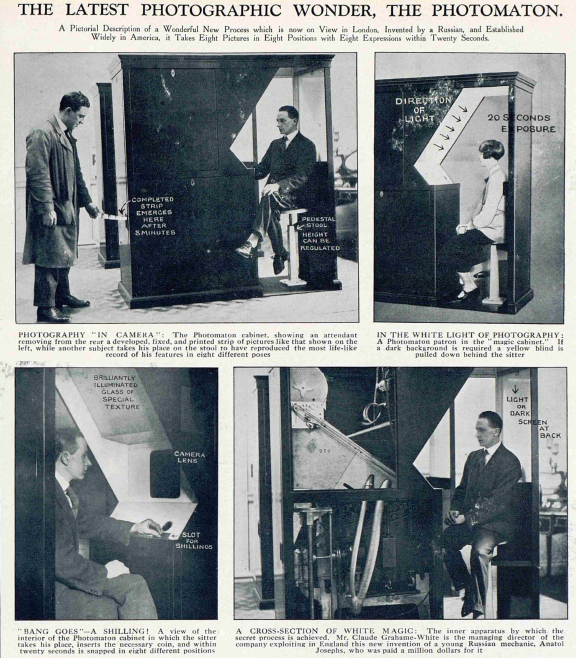
Full page feature on the Photomaton to mark its arrival in Britain, published in ‘The Latest Photographic Wonder, The Photomaton’, The Sphere, 25 February 1928, 15.
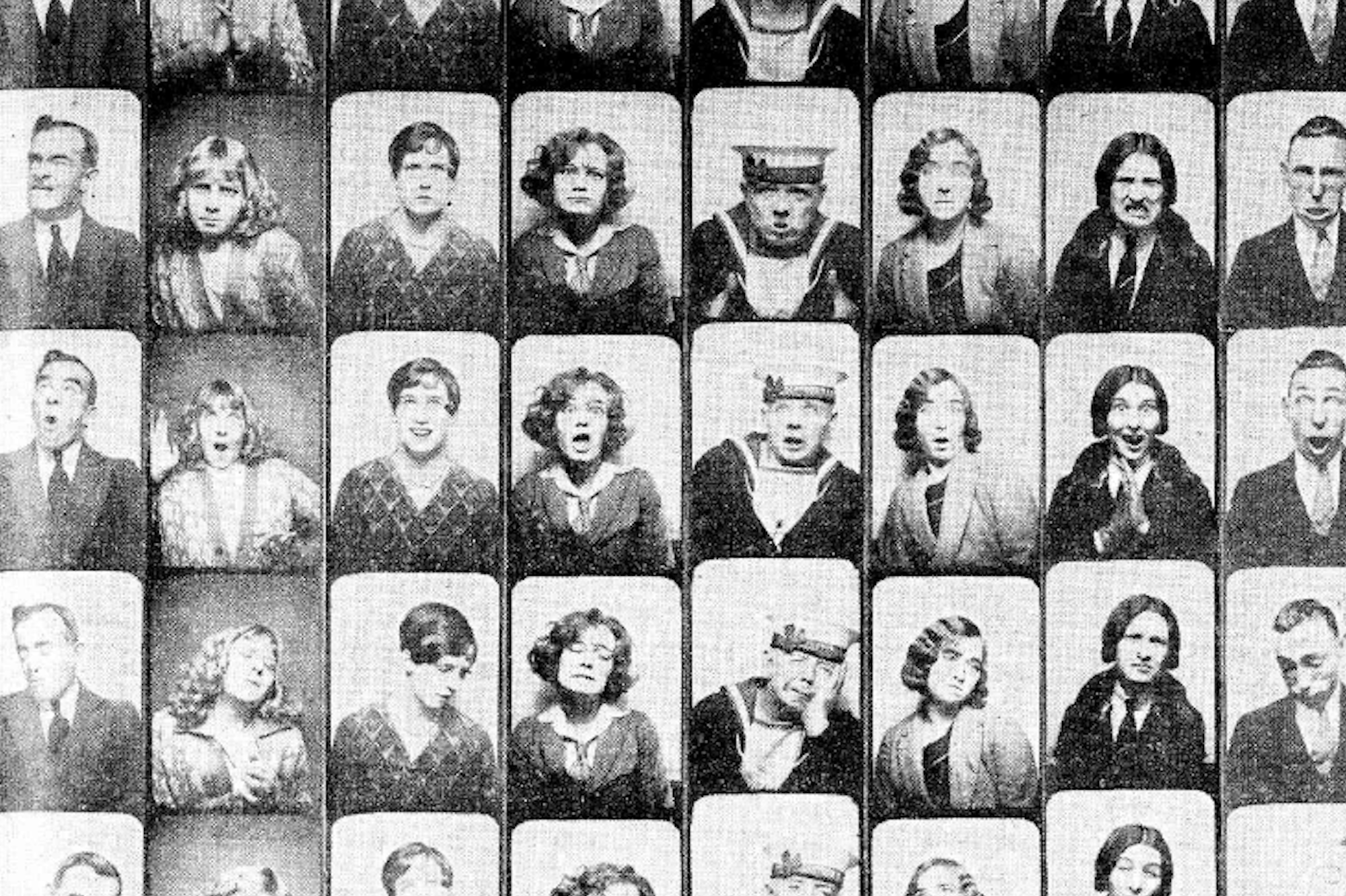
To further increase custom, the British arm of Photomaton ran a series of public competitions. A Photomaton competition in London’s Daily Mirror involved a £4,000 prize and was open to men, women and children. Participants were required to use a Photomaton and across the then five exposures, produce five distinct facial expression; ‘‘Boredom [,] Grief [,] Surprise [,] Pleasure can all be expressed in your face [.] Try on a Photomaton strip and enter for Daily Mirror Summer Photomaton Expression Competition’. (19) Other advertisements for the competition declared, ‘It’s So Easy to Look Bored!’ (20) The resulting strips were submitted to the Daily Mirror, which were then reproduced in the newspaper as halftone prints. The public were then encouraged to vote, which could result in their winning of weekly prizes. (21)
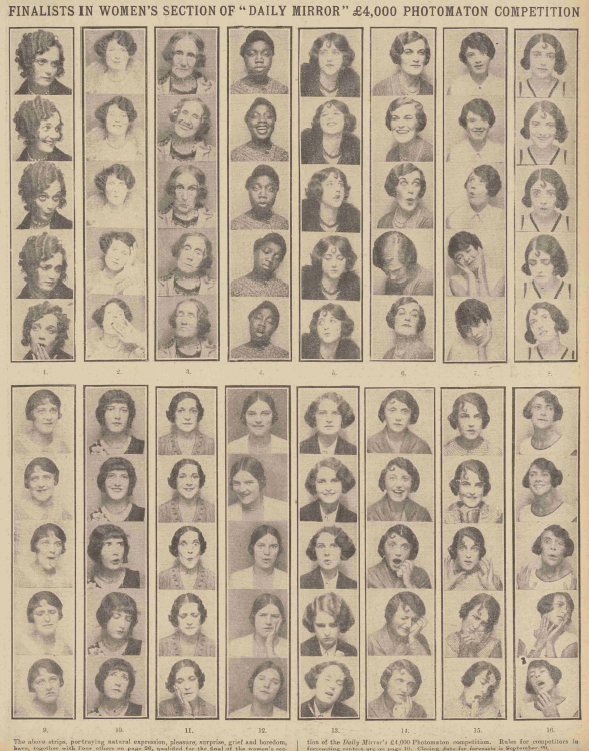
Finalists in the Women’s Section of the Daily Mirror competition, Britain, Daily Mirror, 22 Sept 1928, 7.
The competition’s success in Britain inspired its replication in Australia following the arrival of machines in the country in early 1929. In May 1929, Photomaton partnered with the department store David Jones in Sydney to run the ‘Pictorial-David Jones Great Photomaton Competition’. Entrants were required to have their photographs taken in a David Jones’ Photomaton, where they had to clearly display ‘six moods – natural, pleasure, anger, surprise, grief and boredom’. (22) Advertisements for the competition, described as ‘the Battle of the Emotions’, asked:
How do you really look? Find out. And at the same time become eligible for big money prizes … Few people know how they really look, because few of us have ever seen ourselves as we appear in a moment of pre-occupation, of surprise, or anger – in any of those characteristic moments when we are just our unstudied selves. (23)
Daily Telegraph readers were entitled to one coupon per day to vote for their preferred entrants, who were then shortlisted and their strips appearing as halftone prints in the paper. (24) Strips appeared regularly in the paper, and make apparent the public’s embrace of the competition, enacting the emotions through actions like exaggerated yawns, desperate sobbing, their hands raised in surprise, gurning or shaking fists. (25)
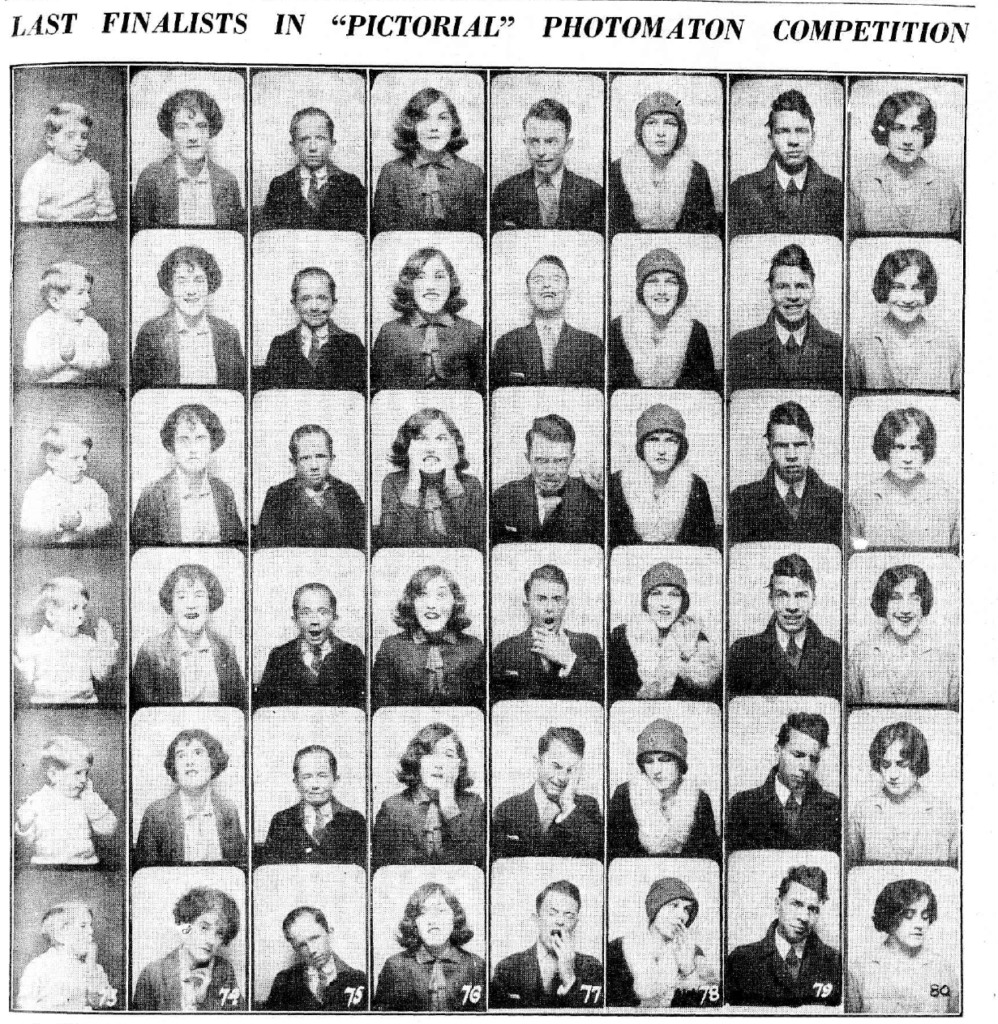
Finalists in the Australian competition in the Daily Telegraph Pictorial, 5 June 1929, 27.
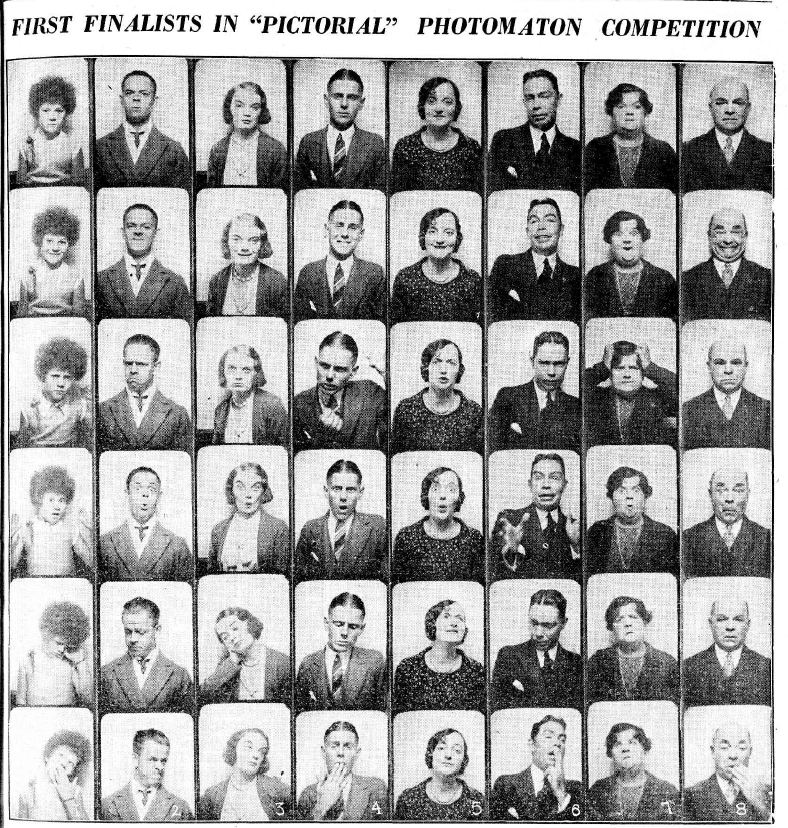
Finalists in the Australian competition, with Addie Wilson on the fat left eventually celebrated as the winner, in the Daily Telegraph Pictorial, 20 May 1929, 21.
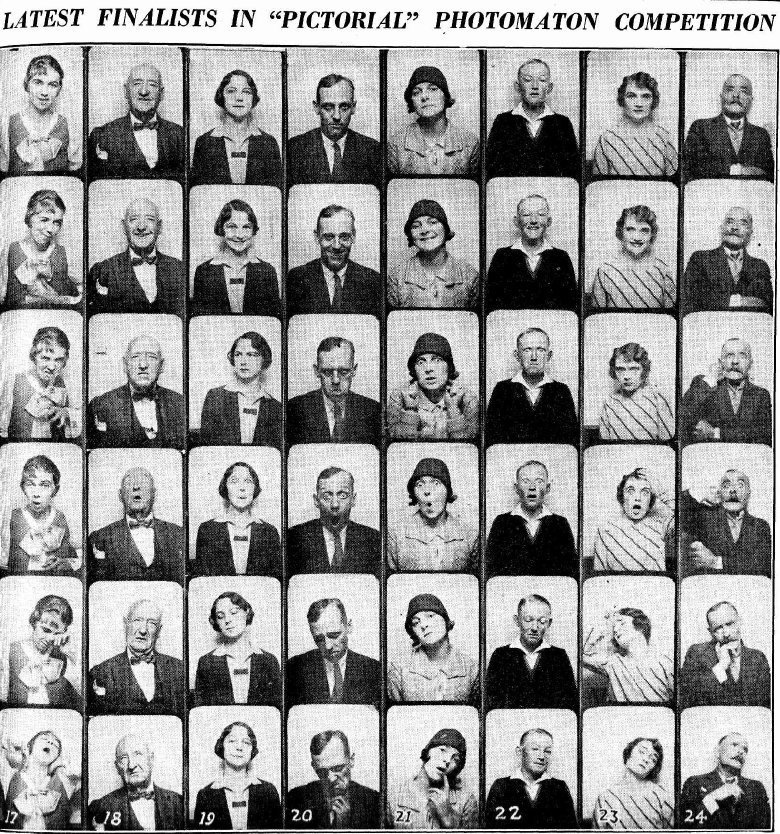
Finalists in the Australian competition in the Daily Telegraph Pictorial, 24 May 1929, 27.
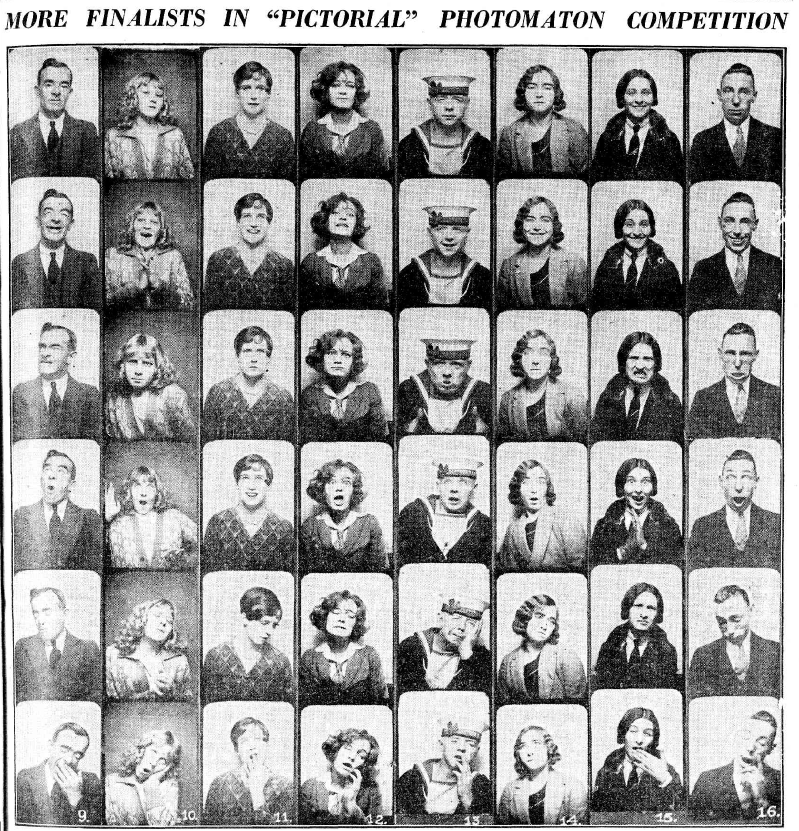
Finalists in the Australian competition in the Daily Telegraph Pictorial, 22 May 1929, 27.
In Britain, the competition aroused suspicions. The June 1928 British of Journal of Photography commented that they ‘may be regarded as sign that the Photomaton business is in need of a tonic’. (26) The article points to the lack of machines in Britain, noting that only 29 were installed as of April, well behind the target of 150 for July, concluding that ‘it seems somewhat improbable that the competition can provide the impetus to Photomaton portraiture which it is obviously designed to give’. (27) By the end of 1929, the Photomaton business failed in Britain. Photomaton’s wider, international iterations closed soon after. But it was not for the factors predicated by the Journal. Instead, falsified dealings by British financier Clarence Hatry, owner of Britain’s Photomaton company, was the root cause. (28)
The success of the machines, and specifically Josepho’s innovative booth design, however, continues to this day. Both analogue and digital photobooths draw on Josepho’s original Photomaton design, cementing the significance of his invention 100 years on.
(1) This is commonly misreported, but extensive reviewing of historic articles indicates this is the date, see, for instance, ‘The Automatic Machine’, The British Journal of Photography 73, no. 3476 (17 December 1926), 736. Josepho submitted patents in relation to the machine in 1923 and 1925. The patent in 1925 most closely resembles the final machine.
(2) Aben Kandel, ‘A Million Dollar Invention: Anatol Josepho’, The American Hebrew 120, no.24 (22 April 1927): 895. This article indicates that Josepho trialled the machine while gaining initial investments.
(3) Ibid.
(4) This was also when the Eiffel Tower first debuted.
(5) Prior to this point, a patent was filed by Spanish watchmaker Juan Ferrer y Girbau and German-born, American-based Matthew J. Steffens in collaboration with the Franklin Electric Company.
(6) ‘The Automatic Photographer’, The Australasian Photographic Review (24 August 1899): 8; in Melbourne, the Bosco Automat was exhibited in the rooms of W. Newham at 138 Swanston Street, see ‘Brief Mention’, Herald (21 December 1899): 4; a further machine was invented by The Automatic Photograph Company, Limited, based in West Bromwich, London in 1890, Americans Pierre Welsh and William Freeman patented the Welsh’s Slot Photograph Machine in 1891, among many others.
(7) ‘Your Photo by Slot Machine’, The World's News (5 February 1927): 14; The Commercial Photographer 2, no.1 (October 1926): 70; see also ‘Your Picture Made by Photomaton’, Photo-Era Magazine 57 (November 1926): 282; later articles compared the machine to a ‘cabinet’. In Europe, photobooths are sometimes referred to as ‘photo cabines’. Booth structures were used for public telephones since the 1880s in Germany, but the most popular phone booth was that of British architect Giles Gilbert Scott, the iconic red phone booth, or box, which was publicly released in 1924.
(8) ‘Birth of a Giggle’, Birmingham Daily Gazette (27 November 1926): 7
(9) ‘You Picture Made by Photomaton’, Photo-Era Magazine 57 (November 1926): 282; a discussion on ‘ping pong’ photographs can be seen in W. Clement Moore, ‘Success in Advertising a Photographic Business’, Bulletin of Photography 16, no.398 (24 March 1915): 365; 364-6.
(10) Penny photographs were immortalised in Walker Evans’ 1936 photograph Penny Picture Display, Savannah.
(11) ‘Birth of a Giggle’, Birmingham Daily Gazette, 27 November 1926, p. 7
(12) They were also present to encourage sales of Photomaton enlargements. These enlargements were a key component of the Photomaton’s business strategy, offering users the opportunity to purchase an enlarged version of their favourite frame. This was then printed and mounted on card to replicate offerings by more traditional photography studios.
(13) Mary Elizabeth Prim, ‘Photos Without Tears’, Photo-Era Magazine 59, no.5 (November 1927), 302.
(14) £200,000 FOR INVENTION: EVERY MAN HIS OWN PHOTOGRAPHER’, The Times of India (23 April 1927): 13; ‘’When a Dream Came True’, Photo-Era Magazine 58, no. 5 (May 1927): 301.
(15) Douglas Gomery, ‘Warner Bros. Introduces Talking Motion Pictures’ <https://www.ebsco.com/research-starters/history/warner-bros-introduces-talking-motion-pictures>
(16) ‘Birth of a Giggle’, Birmingham Daily Gazette, 27 November 1926, p. 7
(17) ‘SLOT PHOTO DEVICE BRINGS $1,000,000 TO YOUNG INVENTOR’, New York Times (28 March 1927): 1.
(18) Daily Mail (27 March 1928): 26.
(19) The Staffordshire Sentinel, 25 June 1928, 7
(20) The Daily Mirror, 19 July 1928
(21) Images of the winners were reproduced in the Daily Mirror following the announcement of the victors in early November 1928 see Daily Mirror, 3 November 1928; and image of the child was reproduced again in Daily Mirror, 5 November 1928.
(22) ‘Closes a Week From To-Day’, Daily Telegraph Pictorial, 28 May 1929, p. 2.
(23) ‘£100 to be Awarded in Photomaton Competition’, Daily Telegraph Pictorial, 13 May 1929, p. 2.
(24) Daily Telegraph (Sydney, NSW : 1883 - 1930), Saturday 8 June 1929, page 5; With a total of sixty-six finalists, seven-year-old Addie Johnson of Ryde, New South Wales, won the top prize of fifty pounds; ‘Winning Faces in the Big Photomaton Competition’, Daily Telegraph Pictorial, 15 June 1929, p. 8.
(25) ‘The Battle of Emotions: Photomaton Competition Votes Pour In’, The Daily Telegraph, 8 June 1929, p. 5; ‘Last Finalists in “Pictorial” Photomaton Competition’, Daily Telegraph Pictorial, 5 June 1929, p. 27; see also ‘Latest Finalists in “Pictorial” Photomaton Competition’, Daily Telegraph Pictorial, 24 May 1929, p. 27; McKean did not win, but the directors of David Jones decided to award him two guineas for his ‘clever registrations of the required six expressions’, see ‘David Jones Give Two Guindeas to 3-year-old Entrant’, The Daily Telegraph, 7 June 1929, p. 3.
(26) ‘Photomaton Again’, British Journal of Photography, 29 June 1928, no. 3556, vol. lxxv, p. 1-2
(27) ‘Photomaton Again’, British Journal of Photography, 29 June 1928, no. 3556, vol. lxxv, p. 1-2
(28) See for instance the report in Singapore’s main newspaper, ‘Hatry Sensation’, 30 September 1929, p.12.


