
by Lucía Harari
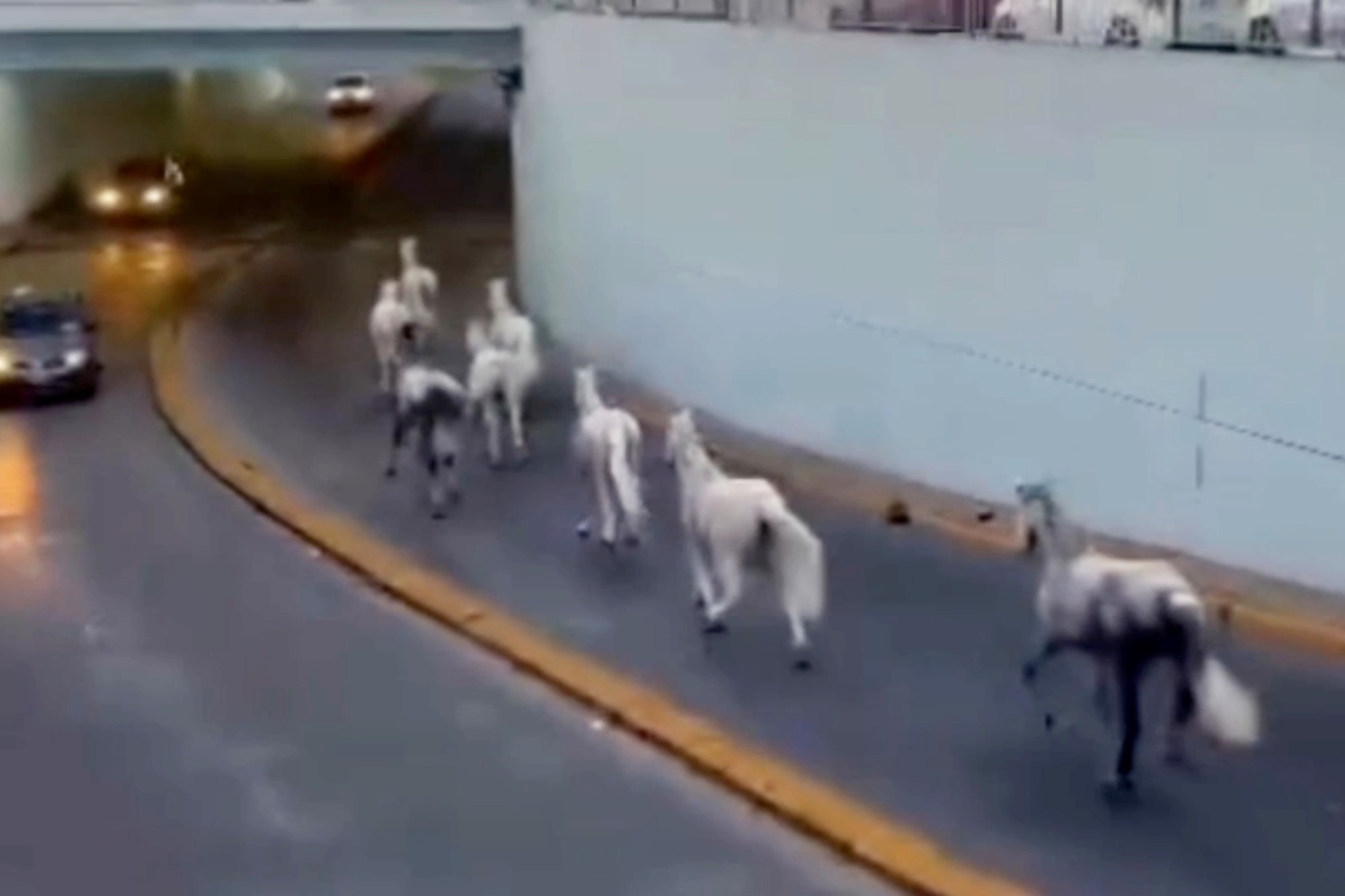
The project 'Fuga Panamericana' (or 'Pan-American Escape') is presented as a video essay based on an event that occurred in 2024: the escape of 46 horses from the Argentine Army along the Panamericana highway.
This episode, barely witnessed live by a few people, circulated primarily through mediated versions: photographs taken at random, fragments of news broadcasts, and memes shared on social media. The escape – easily mistaken for a dreamlike scene or a piece of fiction generated by artificial intelligence – was collected by Lucía Harari into an immediate and collective archive.
Lucía Harari was one of the recipients of the 2025 Eidolon Grant, and the video was produced with the support of the grant.
We are very pleased to finally present the completed work.
Let only the horses remain. What if the army's horses escaped because they no longer wanted to hear the trumpet in their ear, nor the whistling of military fanatics?
This hypothesis opens up a series of questions that drive this video-essay: Where are they going? Are they returning to their origin? To la Querencia—that word describing the instinctive pull toward the place of origin? To the comforts of the regiment? Are they fleeing the ghosts left behind by the Dictatorship?
This event led me to reflect on whether I, too, am in flight. There is something about wanting to escape, about moving from one place to another, about not knowing very well right now what freedom would even mean, that makes me kin to the deserter horses.
This essay is, ultimately, a search for a panoramic point of view: between culture and the wild, between civic poetics, scientific poetics, and the poetics of the land, between the documentary archive and a bit of generated fiction.
NOTES
General José de San Martín, after studying in Spain, founded an elite regiment, the Mounted Grenadiers, a symbol of the Americas' independence from the Spanish Empire.
The curved saber is the emblem of the defense of American sovereignty that San Martín acquired in London and donated to the National History Museum, from which it was removed by the Argentine president in 2026.
Campo de Mayo was one of the clandestine centers for torture and forced disappearance during the military dictatorship between 1976 and 1983.
A TIMELINE OF EVENTS
¿ ? – Native-American horse had gone extinct (fossils exist at the Paleontological Museum of Trelew, Argentina)
1493 – Andalusian and Arab horses are shipped by Christopher Columbus from Spain to the Americas
1811– 1819 General José de San Martín acquires the curved saber in London, found the Mounted Grenadier Regiment, organizes the Army of the Andes, led the Crossing of the Andes and returns. Although he is often pictured victorious on a white horse, records show that he completed several stretches of the journey carried on a stretcher and by mule due to his health problems
1925 – Gato and Mancha travel across the American continent from south to north
1944 and 1947 – Gato dies at age 36 and Mancha at age 40, "having lived a quiet retirement"
1976–1983 – The Campo de Mayo grounds operated as a clandestine center for torture and forced disappearance
1997 – A horse joins the peloton of France's Critérium International
2024 – Military horses escape from Campo de Mayo, Argentina
2024 – Military horses escape and run through the streets of London
2026 – A horse throws a Grenadier in front of the president
2026 – A horse rears up in front of the presidential car
2026 – Military horses escape and run down Avenida Cristóbal Colón in Rome
This work was supported by the Eidolon Grant 2025 programme of Eidolon Centre for Everyday Photography. The Spanish version is available at this following link.


