Foreword
Only photographs and film footage preserve their memory
Miklós Tamási
The afterlife of the 1956 Revolution is closely bound up with the afterlife of the dead, victims, and those sentenced to death. Throughout the decades of socialism, not only the history of the revolution but the history of the dead was untouchable. Hundreds of families, even decades later, could learn only by hearsay where their loved ones had found their final resting place. One of the founding narratives of the 1988–89 regime change was the search for, and subsequent reburial of, the graves and remains of the executed – including Prime Minister Imre Nagy and his comrades.
The sight of the revolution’s dead is a familiar one: the body lying in the street appears in countless photographs and contemporary film footage. We see the bodies of Soviet soldiers doused in lime or burned black inside blazing tanks, of ÁVH officers executed as victims of lynching, and of insurgents covered with the national flag. We see the innocent victims of ‘Bloody Thursday’ at Kossuth tér, or of the volleys at Mosonmagyaróvár. Many also took photographs during funerals and in mortuaries during the revolution. And here and there, we also see graves in public spaces. This project deals with the latter: the graves of those buried in public spaces during the days of the revolution.
At first it seems almost incomprehensible that in the autumn of ’56, insurgents were also buried, out of necessity, in parks and on small patches of grass around statues. It is hard to imagine, but for two weeks in Budapest, even the removal of the dead ran into difficulties. And there were dead: as early as the night of 23 October, several people had already been killed in the gunfights around the Radio building. The memory of those buried in public spaces is also incomplete (if it existed at all), because the graves were secretly exhumed in early 1957, and everything disappeared without a trace. The graves – simple crosses that, on All Saints’ Day in 1956, were still covered in flowers and candles – had, barely a year later, already sunk into oblivion. Only photographs and film footage preserve their memory.
In this project, we set out to trace some of these graves and to create a memorial marker on the original sites. For this, we can rely on the photographs alone. It is rare for the sole evidence of a historical event to be a single photograph. There are no witnesses and no testimonies, no records were made, and no investigation was ever carried out. No list was ever compiled of the graves, and the names of the victims are not known. The sole piece of evidence, then, is the photograph: the photographs show that bodies lay hidden beneath the ground at Ferenciek tere, at Rákóczi tér, at Bakáts tér, and at a dozen other squares across Budapest.
Since our research is founded on the photograph, we wanted to create a memorial marker – in Greek, a stele, that is, a gravestone – of which the photograph itself would form a part. The evidence. This is how the stelae installed at the three sites came to be, designed by Hetedik Műterem and SUBMACHINE. At the top of each of the three objects is the photograph taken at that particular site: powerful evidence captured by the amateur photographers of the ’56 Revolution.
Locations
Context
Temporary Graves, Exhumations, and Reburials – The Afterlife of the Dead of 1956
László Eörsi
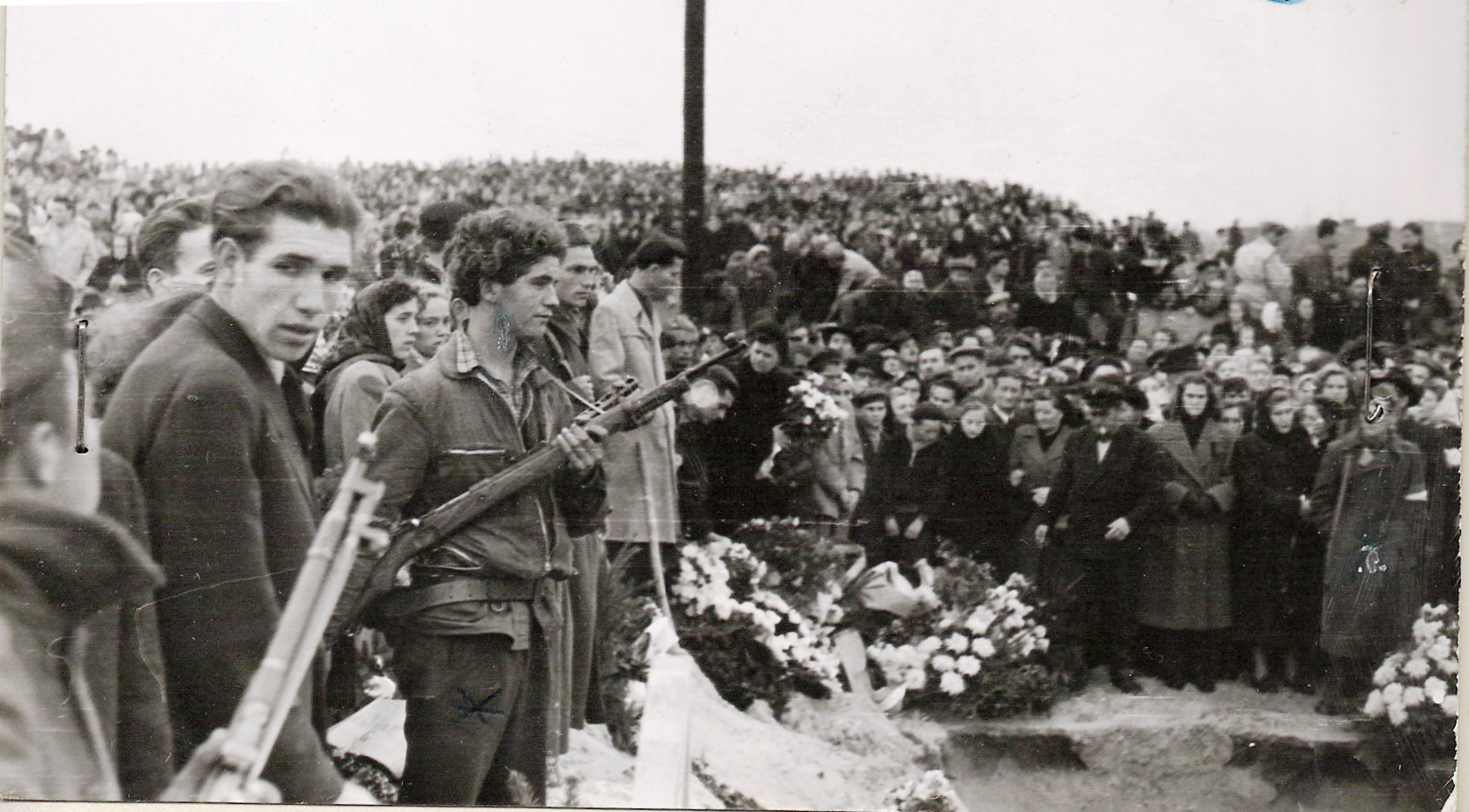
Pesterzsébet, funeral, 31 October.
Trial records of Béla Kálmán and others. Military History Archives, 071/59, p. 358.
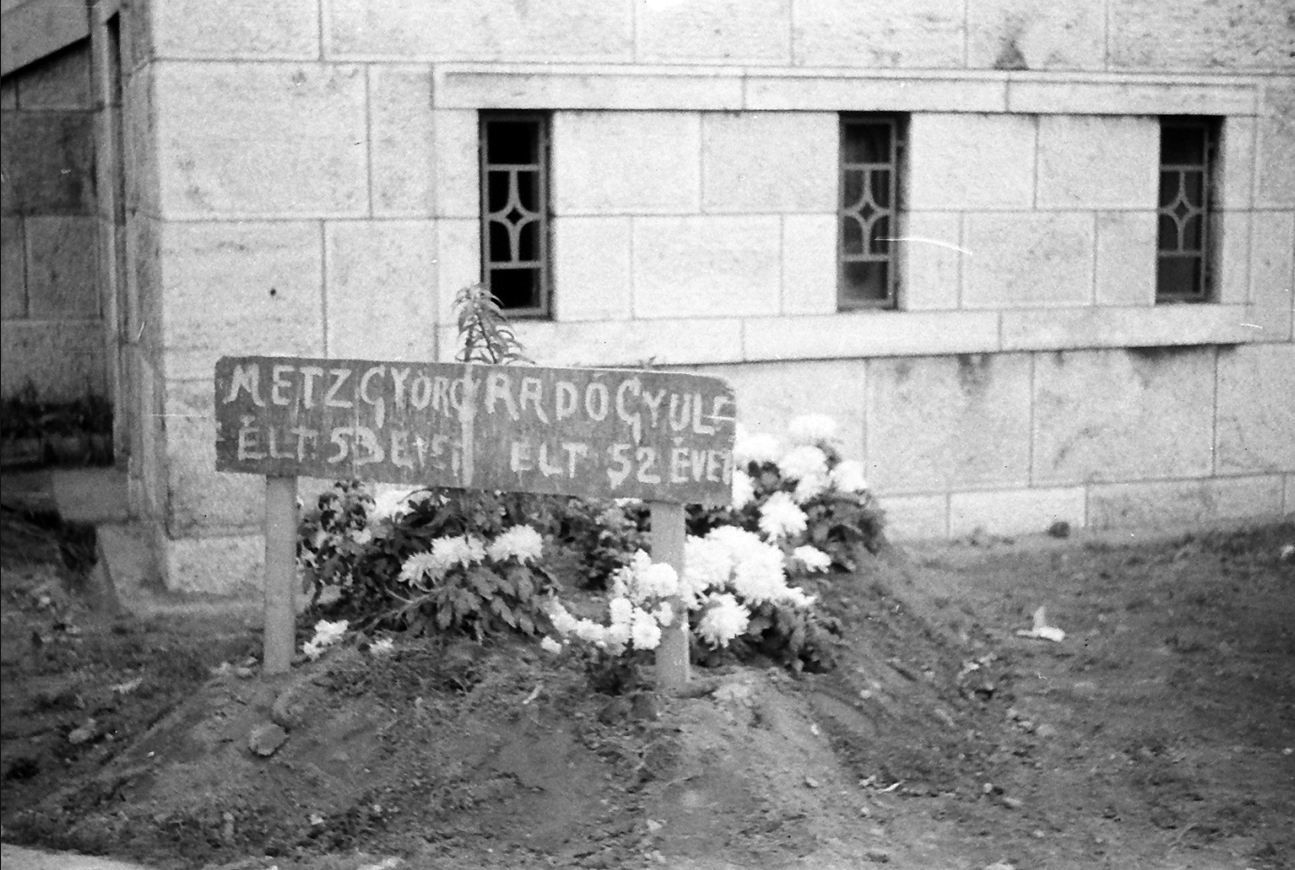
The grave of András Mink's grandfather
Fortepan / Juricza Tibor
In Budapest, the burial of the dead of the 1956 Revolution generally departed from established practice: circumstances mostly made it impossible to take them to a cemetery, so the bodies of the fallen were placed – temporarily – in gardens, in courtyards, near hospitals, or close to the battle sites. Later, some of those buried temporarily were identified, and it was then that their remains were taken to a cemetery.
The reconstruction of this process is made difficult by the fact that the first burial place often did not coincide with the final resting place, and that records of the reburials have not always survived.
In addition, the sources are not equally precise. There are graves in public spaces documented by photographs, burials preserved in recollections, cemetery registers, and later exhumation records, but these do not form a single, complete database. For this reason, a complete list of locations cannot be compiled with certainty even today. From the places that can be documented, however, the practice of makeshift burials emerges, along with some important moments in the later removal of the temporary graves.
Makeshift Burials in Public Spaces
By 21 November, around a thousand of the fallen had been taken to cemeteries. At that point, there were some four hundred unburied dead.¹ Because of the heavy fighting, the dead were also buried in public spaces, gardens, and courtyards.² In several places a wooden post, an inscription, or a photograph was placed on the graves; these grave markers later helped with identification.³
The largest locations in public spaces where several graves can be documented are Bakáts tér, Ferenc tér, Károlyi-kert, Rákóczi tér, Kálvária tér, Molnár Ferenc tér, and Felszabadulás tér (now Ferenciek tere).
On the basis of the surviving sources, those buried in public spaces cannot be placed in any single social or political category. Those buried in public-space graves included insurgents or unarmed civilians (children too⁴) as well as regime-loyal paramilitaries. At that time, naturally, the political distinction that the Kádár regime later applied in registering and burying the dead was not yet apparent: in 1958, the Communist victims were reburied in separate plots.
The starting date cannot be established precisely, but a grave in a public space can be reliably documented in Károlyi-kert⁵ as early as 24 October, at the very beginning of the revolution. On 13 November there were certainly still graves in Rákóczi tér.⁶ Evidence from an even later date is a photograph taken on 3 December 1956, although we do not know where it was taken. The inscription on the grave reads ‘Pál Fehér Jr lived 18 years’.⁷ This photograph proves only that on that day at least one such grave still existed. It cannot be ruled out that burials in public spaces continued even later, but this can be documented only up to 3 December.
The date on which the graves in public spaces were removed entirely cannot, therefore, currently be tied to a specific day. By then, the population evidently had to resort to temporary burial because the cemeteries had still not resumed normal operation.
Moreover, temporary burials were not confined to public spaces: hospitals also played an important role. The ArchivNet source publication presents reports from numerous Budapest hospitals, which also record the problems of accommodating and removing the wounded and the dead and of handling the related administration.⁸
Temporary Graves and the Role of the Fiumei Road Cemetery (Kerepesi Cemetery)
For some of the burials, the first grave really was only a transitional resting place. The case of Attila Gérecz documents this especially well. Gérecz died in the Budapest fighting on 7 November. His first grave was in Klauzál tér. On 11 February 1957 he was reburied in plot 21 of the Fiumei Road Cemetery. Later, however, this too proved not to be a final resting place: in 1977 he was moved to the Újpest Cemetery (Megyeri Road), and in 2001 he was returned to plot 21 of the Fiumei Road Cemetery.⁹
In 1956 the Fiumei Road Cemetery was formally a closed, protected burial ground and National Pantheon. During the revolution, however, it was opened, and a significant number of the victims of the fighting were buried in plot 21, close to the Kossuth Mausoleum, at that time still without political distinction.¹⁰
Most of the dead buried in public spaces were later exhumed and taken to the Kerepesi Road Cemetery. It is most likely that the Budapest municipal funeral service carried out this work.
In 1956 and the first months of 1957, a total of 574 of the fallen were buried in the Fiumei Road Cemetery, and not all of the dead were buried in plot 21.¹¹
The Political Segregation of the Dead
In the consolidation that followed the revolution, burial also acquired political significance. In the creation of the Pantheon of the Labour Movement, the spatial organisation of the cemetery was bound up with the shaping of Communist historical memory.¹²
In 1958, the Kádár regime also removed its own dead from plot 21. Those of higher rank were reburied in plot 13, in the row of honour in front of the labour movement mausoleum then under construction, while the lower-ranking paramilitaries were placed in the Martyrs’ Graveyard established in plot 5.¹³ Thus plot 21 remained one of the burial places of the dead of the revolution. It is no coincidence that the authorities also attempted to clear the plot physically in 1982, citing the expiry of the decomposition period.¹⁴ Yet both the relatives’ resistance and the international reaction played a role in the survival of the graves.¹⁵
The largest number of Soviet soldiers, 347, were buried in the Kerepesi Cemetery. The second large group, 120, were placed in mass graves set up on the outskirts of Alsónémedi. In Buda, around fifty soldiers were buried in mass graves established at the statue of Captain Ostapenko; a further 44 were buried at battle sites in Pest and four in Buda – temporarily. In the case of Soviet soldiers, a precise answer about where each one now rests can be given only person by person.¹⁶
Difficulties of Identification
The reconstruction of the burials is also made difficult by the fact that the identity of the fallen could not always be determined immediately. Graves in public spaces sometimes bore inscriptions that gave no name or only partly identified the person. At other times, relatives or photographs placed beside the grave helped with identification.
Photographic grave markers could therefore play a dual role: on the one hand, they marked the identity of the dead person; on the other, they displayed the loss publicly.¹⁷
In the case of Soviet soldiers, there are discrepancies. The same person’s name sometimes appeared in several places, and the inscription on a given gravestone did not always make it clear whether differing details referred to another person. For this reason, in reconstructing the burials of Soviet soldiers, it is especially important to keep three pieces of information apart: the place of death, the place of the first burial, and the later resting place.¹⁸
Temporary Graves as Sites of Remembrance
In the days of the revolution, temporary graves were places of mourning and remembrance. They were decorated with flowers, candles, and grave lanterns, and, if known, the dead person’s name, and even their age, was written on them.¹⁹ These graves became places of reverence above all on 1 November, All Saints’ Day: according to surviving photographs, people lit candles, laid flowers at the graves in the streets, and remembered the victims of the fighting.²⁰ The largest funeral took place on 31 October in Pesterzsébet, where 22 insurgents had fallen at the ATRA factory. An enormous crowd attended, National Guardsmen provided security, and their commander even ordered a ceremonial volley.²¹
This spontaneous act of reverence thus created, already during the revolution, a public form of remembrance in which mourning, respect for the victims, and the interpretation of the revolution were linked.
Personal Accounts of the Burials
Account by Historian László Csősz, 2026
According to family memory and fragmentary archival records, my grandfather, József Pohorelszky, a 32-year-old unskilled labourer, set out from their home, the house at Nagyszombat utca 3 in District III, to get bread on 7 November 1956. They were raising seven children from my grandmother’s first marriage and three of their own, the youngest still an infant at the time. We do not know whether he had taken part in the events earlier. As soon as he stepped out of the gate, he was hit by a burst of machine-gun fire, presumably fired by Soviet soldiers from the neighbouring Textile Printing Factory building. He died on the spot and was hastily buried in the nearby playground. He was later exhumed and laid to rest in the Óbuda Cemetery. After that, my grandmother, in conditions of severe hardship, raised the ten children on her earnings as a flower seller, among them my mother, who was three years old at the time of the tragedy.
Account by Historian András Mink, 2026
My maternal grandfather, Gyula Radó, was a civil servant with a law degree who worked at the Ministry of the Interior. In 1956 he was 52 and was not an active participant in the events. After the outbreak of the revolution he stayed at home. He lived as a widower in a building on the corner of Lónyay utca and Boráros tér, with his two daughters, my mother and her older sister.
I do not know the exact date, but it was probably in the last days of October, when the radio announced that people could now go shopping. My grandfather and his neighbour set out together to shop, but as soon as they stepped out of the gate of the building, a burst of machine-gun fire killed them.
It never became clear what exactly happened. It is known that Boráros tér was one of the city’s hot spots. Most likely, a sufficiently nervous Soviet patrol or the gunner of a machine-gun nest stationed there opened fire, perhaps not even knowing that the curfew had been suspended, and shooting at every movement. My grandfather was therefore an innocent civilian victim.
In those days, of course, there was not always time for a proper funeral. My grandfather was buried temporarily at the foot of the bridge, presumably together with his neighbour. A proper funeral followed later; his grave is in the Farkasrét Cemetery, and his name is also on the 1956 memorial plaque at the cemetery’s main entrance.
My mother and her sister, having thus been left completely orphaned, were taken in by their aunt in Mohács.
I am attaching the picture I found on Fortepan. This is my grandfather’s temporary grave at the foot of Petőfi Bridge.
The Total Number of Victims
The number of victims of the revolution and the reprisals exceeded 3,500 in total. Between 23 October and 16 January, 2,652 Hungarians sustained fatal injuries, while 669 Soviet soldiers fell. In the reprisals, 226 revolutionaries were executed.
Key Sources and Literature
- ‘A Vigilia beszélgetése. Almási János visszaemlékezése az 1956-os eseményekről’ [The Vigilia Conversation: János Almási’s Recollections of the 1956 Events]. Interview by Sándor M. Kiss. Vigilia 61, no. 10 (1996): 788–794.
- Apor, Péter. ‘Immortalitas imperator: a Munkásmozgalmi Panteon születése’ [Immortalitas Imperator: The Birth of the Pantheon of the Labour Movement]. Aetas 17, no. 2–3 (2002): 179–205.
- Bognár, Katalin. Halottak napja, 1956 [All Souls’ Day, 1956]. Budapest: Hungarian National Museum, 2024.
- Boros, Géza. ‘Eltemetett képek. Fotóhasználat az 1956-os forradalom emlékkultuszában’ [Buried Images: The Use of Photographs in the Commemorative Cult of the 1956 Revolution]. Mozgó Világ 33, no. 1 (2007): 75–85.
- Eörsi, László. A pesterzsébeti fegyveres ellenállás, 1956 [The Armed Resistance in Pesterzsébet, 1956]. Budapest: 1956 Institute – Historical Archives of the Hungarian State Security (ÁBTL), 2015.
- Gyökös, Eleonóra, Áron Nagy-Csere and Gábor Papp, eds. Fiumei úti sírkert [Fiumei Road Cemetery]. Budapest: National Heritage Institute, 2018.
- Kocsis, Piroska. ‘“Túlzás lenne az 1956. október–novemberi eseményeket háborús cselekményeknek nyilvánítani…” Sebesültek és halottak 1956-ban’ [“It Would Be an Exaggeration to Declare the Events of October–November 1956 Acts of War…”: The Wounded and the Dead in 1956]. ArchivNet 12, no. 5 (2012).
- Lukács, László. ‘Csillagórák’ [Starry Hours]. Vigilia 61, no. 10 (1996): 721.
- Marossy, Endre. Szovjet katonasírok Magyarországon 1956 [Soviet Soldiers’ Graves in Hungary, 1956]. https://marossyendre.5mp.eu, 2016.
- Tóth, Vilmos. ‘A Kerepesi úti temető másfél évszázada’ [A Century and a Half of the Kerepesi Road Cemetery]. Budapesti Negyed 7, no. 2 (1999), issue 24.
- Elesettek, áldozatok, sírok. 1956-os fotógyűjtemény [The Fallen, Victims, Graves: 1956 Photograph Collection]. Metropolitan Ervin Szabó Library.
- National Archives of Hungary.
- Piroska Kocsis, ‘“Túlzás lenne az 1956. október–novemberi eseményeket háborús cselekményeknek nyilvánítani…” Sebesültek és halottak 1956-ban’, ArchivNet 12, no. 5 (2012). Kocsis bases the above on a report of 21 November 1956.
- Kocsis, op. cit.
- Géza Boros, ‘Eltemetett képek. Fotóhasználat az 1956-os forradalom emlékkultuszában’, Mozgó Világ 33, no. 1 (2007): 78.
- Almási János visszaemlékezése az 1956-os eseményekről’, Vigilia 61, no. 10 (1996): 792.
- Fortepan photograph, Károlyi-kert, 1956. Fortepan #39992.
- Elesettek, áldozatok, sírok. 1956-os fotógyűjtemény. Metropolitan Ervin Szabó Library.
- ‘Ideiglenes sír a pesti utcán’. Budapest, 3 December 1956. Photo: Ferenc Kovács; National Archives of Hungary, MTI/MTVA; identifier: 614f5521-7cdb-4407-b09a-9734303a3017.
- Endre Marossy, Szovjet katonasírok Magyarországon 1956. A szovjet katonák 1956. október–novemberi magyarországi veszteségeinek néhány előzetes tanulsága (the author’s website, 2016); on the comparison of the official casualty register with the inscriptions on cemetery graves.
- ‘1956-os áldozatok’. National Heritage Institute. Fiumei Road Cemetery, plot 21.
- Vilmos Tóth, ‘A Kerepesi úti temető másfél évszázada’, Budapesti Negyed 7, no. 2 (1999), issue 24.
- Péter Apor, ‘Immortalitas imperator: a Munkásmozgalmi Panteon születése’, Aetas 17, no. 2–3 (2002): 179–205.
- Apor, op. cit.
- Tóth, op. cit.
- Tóth, op. cit.
- Boros, op. cit.
- Marossy, op. cit.
- Gyula Nagy, Budapest, District V, Károlyi-kert, temporary graves of the fallen of the 1956 Revolution, Fortepan #39992.
- Marossy, op. cit.; on the comparison of the official casualty register with the inscriptions on cemetery graves.
- Boros, op. cit.
- Katalin Bognár, Halottak napja, 1956 (Budapest: Hungarian National Museum, 2024).
- László Eörsi, A pesterzsébeti fegyveres ellenállás, 1956 (Budapest: 1956 Institute – Historical Archives of the Hungarian State Security [ÁBTL], 2015).
Credits
Memorial markers
Erected on the 70th anniversary of the 1956 Revolution by the Municipality of Budapest, in cooperation with the Eidolon Centre for Everyday Photography and Fortepan.
Our collaborators:
Miklós Tamási (Fortepan)
Róza Tekla Szilágyi (Eidolon Centre)
György Simó (Eidolon Centre)
Marcell Esterházy
Architects:
Hetedik Műterem Kft. – Levente Szabó DLA, Balázs Biri DLA, Eszter Mantuano, Dorka Jelinek
Graphic designer:
SUBMACHINE – Ákos Polgárdi
Structural engineer:
dr. Dezső Hegyi
Steel structures:
Attila Bundik, Inoxmester-Team Kft.
Engraving:
Xfer Kft.
Powder coating:
RAL5050
Website
Website texts by:
László Eörsi, Miklós Tamási, Róza Tekla Szilágyi
Proofreading: Bori Zelei
English translation: Zsuzsanna Koós
Webdesign: SUBMACHINE – Ákos Polgárdi
Web development: L²
Typeface: Reform-Grotesk
(With thanks to Forgotten Shapes for their support.)
Memorial markers for the temporary graves of the victims
